
Introduction
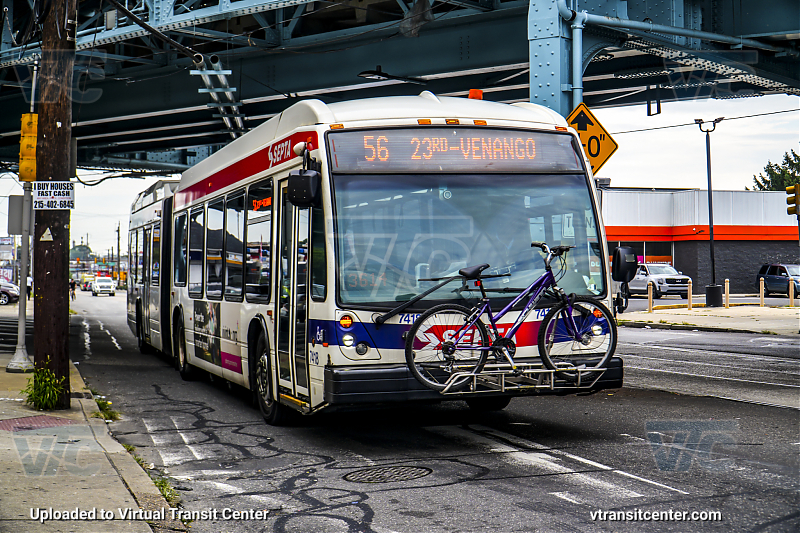
SEPTA Bus route 56 operates from Torresdale-Cottman Loop and 23rd-Venango Loop, (with alternating trips going to Bakers Center) via Erie and Torresdale Avenues. Service on route 56 is provided by Midvale (District 3) depot.
Please Donate!
If everyone reading this could donate just one dollar today, we could afford to have Virtual Transit Center on the web for up to 6 years without interruption, or even the need for ads. For those who enjoy Virtual Transit Center and the services we provide, please consider donating.
SEPTA Route 56 Routing
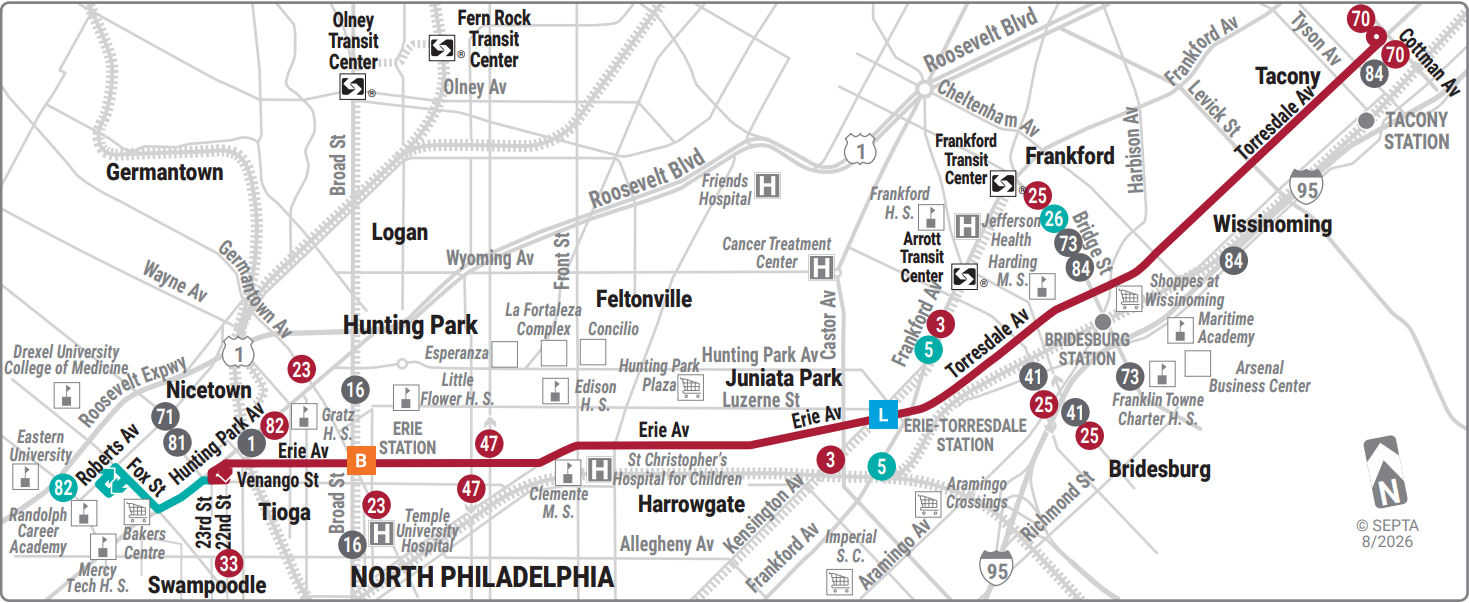
SEPTA route 56 operates crosstown service along the entire length of Erie Avenue, then via Torresdale Avenue to a transit loop at Cottman Avenuue. Westbound trips on route 56 alternate between terminating at Bakers Center near Fox Street and Hunting Park Avenue, and terminating at the 23rd-Venango Loop.

Key Transfer Points on Route 56
SEPTA Route 56 is one of the busiest crosstown routes in the system, and has many transfer points along the way, including…
- 23rd-Venango Loop
- SEPTA Bus routes 1, 33, 71, 81, 82
- Erie Avenue and Broad Street
- Erie Avenue and 9th Street
- SEPTA bus route 4
- Erie Avenue and 5th Street
- SEPTA bus route 47
- Erie Avenue and Front Street
- SEPTA bus route 57
- Erie Avenue and G Street
- SEPTA bus route 76
- Erie Avenue, Kensington Avenue, and Torresdale Avenue
- Torresdale Avenue and Bridge Street
- SEPTA bus routes 25, 26, 73, 84
- Torresdale Avenue and Cottman Avenue
- SEPTA bus routes 28, 70, 84
Route 56 Origins
Current SEPTA Route 56 started off as a streetcar line like most of SEPTA’s modern bus routes. However route 56 wasn’t always a full crosstown line.
The route 56 we all know, was originally two lines:
- Trolley Route 56 operating between 23rd-Venango Loop and 2nd-Tioga via Erie Avenue
- Trolley Route 58 operating between Frankford-Arrott and Torresdale-Cottman Loop via Margaret/Orthodox and Torresdale Avenue
Route 58 via Torresdale Avenue, 1903-1928
Route 58 was started on August 26th, 1903, operating trolley service Frankford-Arrott Terminal and Torresdale-Cottman via Torresdale Avenue. The line would take Margaret Street east to Torresdale for Northbound trips, or Margaret Street east to Worth Street, then Orthodox Street back west to Frankford-Arrott Terminal on Southbound trips. This line would change ends in both directions, instead of circle through loops.
On November 12th, 1922. route 58 would be re-routed to operate in both directions on Torresdale Avenue between Margaret and Orthodox Streets. The diversion over to Worth Street would be discontinued. Torresdale-Cottman loop would be opened on July 24th, 1923, and all trolleys would terminate inside the loop instead of reversing directions at Cottman Avenue. Finally, on September 9th 1923, the line would be through-routed on Frankford Avenue, and no longer reverse directions at Arrott Terminal. This line would ultimately be discontinued on September 1st, 1928, and replaced with an extension of route 56 crosstown service.
Route 56 History 1907-1919
Route 56 was created on March 18th 1907, and was one of the first crosstown trolley lines in the system. This line operated as the “Erie Avenue Crosstown” until October 1st 1913, when it was assigned the route number 56. This line operated between Pulaski-Hunting Park and 2nd-Tioga via Erie Avenue. Like other lines, this route would reverse ends at both ends instead of serving a loop. On April 23rd 1915, it would be re-routed to operate to 18th and Hunting Park instead of Pulaski. The service on Pulaski Avenue would be discontinued on September 27th, 1919, and replaced with an extension of route 49 (now route 53). The route 56 would instead be extended west on Erie Avenue, terminating at 22nd and Erie, eventually looping around via 23rd Street and Venango Street.
Route 56 History, 1920-1928
Route 56 would continue operating from 22nd-Erie to 2nd-Tioga until June 29th, 1926, when the 23rd-Venango Loop opened. Service on route 56 would now terminate and loop around at this loop instead of on Erie Avenue. Service would be extended eastbound to Frankford Avenue on December 4th, 1927. This would also mark the first time that route 56 could finally loop around on both ends, instead of having to reverse directions. This also marks when route 56 finally operated the entire length of Erie Avenue. On September 2nd 1928, route 56 would be extended east to Torresdale-Cottman loop via Torresdale Avenue. This effectively replaced all service on the former route 58 trolley. Service on route 56 would begin to alternate between terminating at Frankford Avenue or at Cottman Loop, especially during the rush hours. Over time, the Frankford Avenue cutback would be reduced to emergency cutbacks only. There were additional trips on route 56 that would start at, or operate via 10th-Luzurne, the location of Luzurne bus/trolley depot, during peak hours. In 1987, there was a shuttle bus that had route 56 tolley operating between 23rd-Venango and Frankford-Torresdale, and passengers could transfer between bus and trolley at Kensington Avenue. When the shuttle bus was over and trolleys returned to Cottman Loop, the Frankford Loop would remain unused except for emergency cutbacks through the fall of 1992, when route 56 would lose its trolley service.
Modern Route 56

Unlike most bus and trolley routes in the city of Philadelphia, route 56 as a whole would remain untouched until fall of 1992, when trolley service would be “temporarily removed” from route 56. Overnight service on route 56 would also be removed around this time. When buses fully took over, the trolley right of way would remain unused, except between Old York Road and Broad Street on Erie Avenue. This would remain true until 2023, when bus lanes were created between 13th and Broad Streets on Erie Avenue.
In 2003, Frankford Terminal closed, and most buses that previously served Frankford Terminal, would be re-routed to serve Erie-Torresdale station instead. During this time, buses on route 56 would start stopping at O Street/Erie Avenue, instead of across Kensington Avenue. When the Frankford Buses were sent back to Frankford Transportation Center (now Frankford Transit Center), route 56 buses would make both stops at Erie Avenue/O Street and Torresdale Avenue/Kensington Avenue.
Overnight service on route 56 would be returned on September 4th 2005, although night owl exclusive routes B1 Owl and L1 Owl never called them out int their announcements even today.
In 2008, as part of the “more buses more often” campaign, all trips on route 56 were to operate the full route from Torresdale-Cottman loop to 23rd-Venango loop, the emergency cutbacks at Frankford-Torresdale and school service via 10th-Lycoming would be eliminated.
On September 1st 2013, SEPTA would extend alternating weekday (and all weekend) trips on route 56 west to Bakers Center near Fox Street and Hunting Park Avenue, and the line would see an ever so slight frequency boost from every 10 to every 8 minutes during peak hours.
Beginning September 1st 2019, there would finally be articulated buses used on route 56, Marking the first time since 1992 that SEPTA would use higher capacity vehicles on this route.
Other Routes using the same numbers.
Route 56 was always a crosstown service on Erie Avenue.
A shuttle bus extention of trolley route 59 (named 59B) would be re-numbered to 58. This same route 58 exists today, and operates between Frankford Transit Center and Neshaminy Mall via Buselton Avenue.
New Bus Network Changes
SEPTA Route 56 is currently unaffected by the New Bus Network
Timetables
Route 56 is currently active. Check out SEPTA’s official website for current timetables for route 56. Below are historic timetables for SEPTA Route 56. These are older, out of date timetables for archival educational purposes only. These are not meant to be used for actual trip planning.